
title
[!quote] Definition
A compiled representation of a regular expression.
A regular expression, specified as a string, must first be compiled into an instance of this class. The resulting pattern can then be used to create a
Matcherobject that can match arbitrary java.lang.CharSequence character sequences against the regular expression. ==All of the state involved in performing a match resides in the matcher==, so many matchers can share the same pattern.A typical invocation sequence is thus
Pattern p = Pattern.compile("a*b");
Matcher m = p.matcher("aaaaab");
boolean b = m.matches();
1. Pattern::compile
Pattern의 생성자는 private으로 외부 접근이 제한되어 있는 대신, 정적 팩토리 메서드 compile을 제공한다. 컴파일이라는 동작을 표현하기 위해 사용되었을 뿐, 실질적으로 내부의 생성자를
호출하는 ==대리자==에 불과하다.
/*
 * This private constructor is used to create all Patterns. The pattern
 * string and match flags are all that is needed to completely describe
 * a Pattern. An empty pattern string results in an object tree with
 * only a Start node and a LastNode node.
 */
private Pattern(String p, int f) { ... }

// ...

public static Pattern compile(String regex) {
	return new Pattern(regex, 0);
}

public static Pattern compile(String regex, int flags) {
	return new Pattern(regex, flags);
}
[!info]+ Info: IDE 힌트
IntelliJ에서 조회한 API 문서를 살펴보면
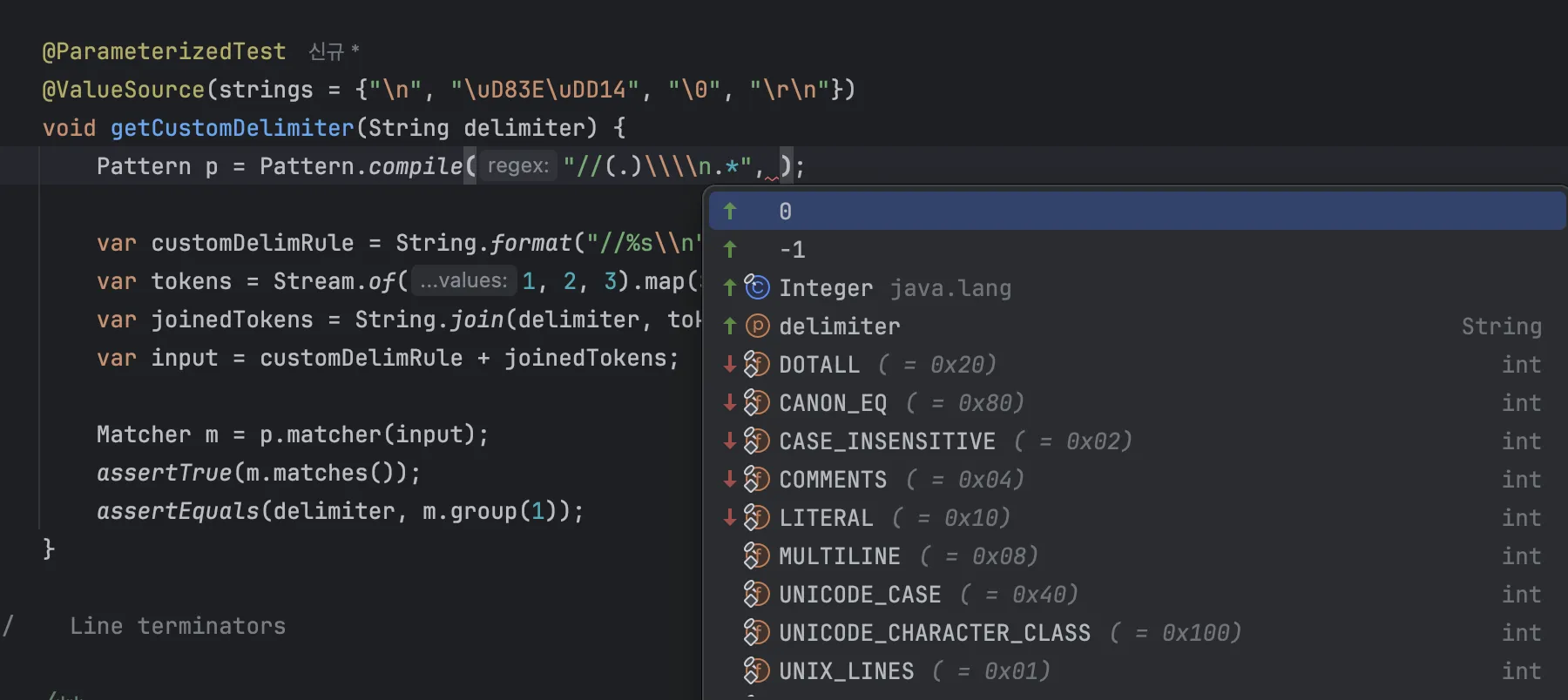
org.intellij.lang.annotations.MagicConstant라는 IDE 내부 어노테이션이 존재한다. 이 덕분에compile메서드의 플래그를 설정할 때, 다음과 같이 해당 클래스에 정의된 상수들을 먼저 추천받을 수 있게 된다. (DOTALL부터UNIX_LINES모두 상수에 해당)
앞선 정의에 명시되어 있지는 않지만, regex 파라미터에는
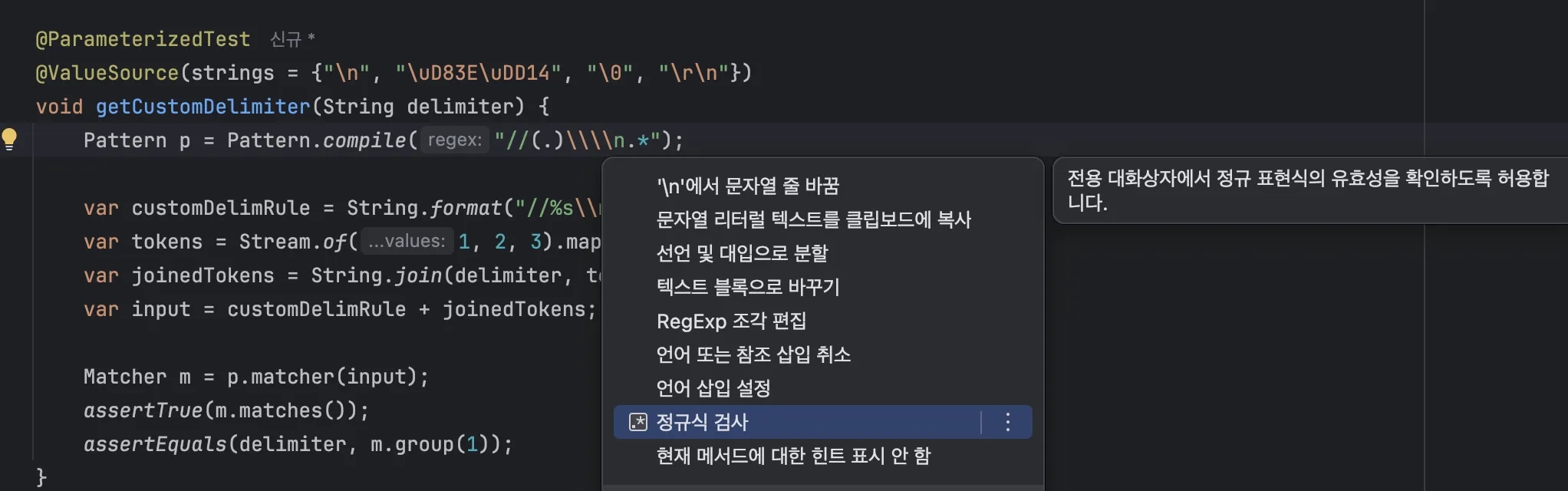
org.intellij.lang.annotations.RegExp어노테이션이 적용되어 있다. 컴파일러에겐 모두 동등한 String이겠지만, 이 어노테이션 덕분에 IDE에서는 정규 표현식으로서의 문자열로 인식되어 컨텍스트 액션으로 정규식 검사를 추천받을 수 있다.

2. 클래스의 역할
==1. 패턴 문자열, 2. 플래그 설정== 값을 컴파일해서 적절한 Matcher를 만드는 것이 주요 목적이다.
이러한 클래스 디자인은 주석에서도 잘 드러난다.
- 문자열로 구체화된 정규 표현식은 먼저 이 클래스의 인스턴스로 컴파일되어야 한다.
- 2개의 유일한 직렬화 요소: the pattern string and the flags
[!quote] Docs
/*
* A regular expression, specified as a string, must first be compiled into an instance of this class.
*
* Pattern has only two serialized components: The pattern string
* and the flags, which are all that is needed to recompile the pattern
* when it is deserialized
*/
2-A. Matcher 팩토리
실질적으로 문자열을 받아 패턴 비교를 수행하는 것은 Matcher의 역할이다. Matcher 클래스는 public으로 열려있지만, 생성자는 package-private로 구성된 것을 보면,
Pattern은 정규 표현식 컴파일로 초기화가 필요한 ==Matcher의 팩토리 클래스==로 이해할 수 있다.
/*
 * An engine that performs match operation on a java.lang.CharSequence character sequence by interpreting a Pattern.
 *
 * A matcher is created from a pattern by invoking the pattern's Patter#matcher matcher method. (...)
 */
public final class Matcher implements MatchResult {

    Matcher() {} // No default constructor.

    /**
     * All matchers have the state used by Pattern during a match.
     */
    Matcher(Pattern parent, CharSequence text) { ... )
3. Flags
플래그는 동일한 문법이 환경에 따라 다르게 동작해야 하는 부분들을 커버해준다.
3-A. Pattern.DOTALL
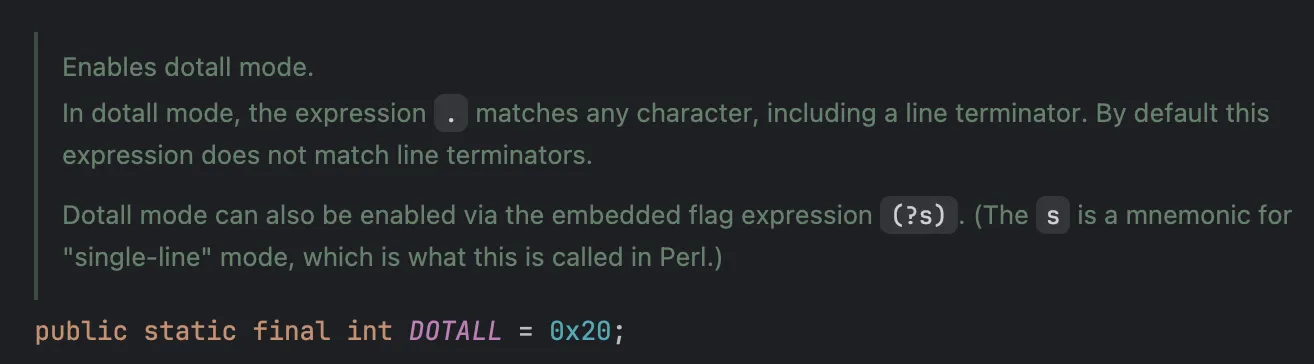
상수에 대한 설명을 보면 line terminator라는 용어가 나오는 것을 알 수 있다. ==줄 바꿈==을 의미하는 문자들을 총칭하는 개념인데, LF, CRLF 결정하는 것처럼 줄 바꿈을 표현하는 문자가
달라질 수 있다는 것만 이해하면 된다.
정규 표현식에서 . (DOT)은 임의의 하나의 문자에 대한 표상이지만, 기본적으로 line terminator는 예외로 둔다. DOTALL은 이러한 기본 동작을 수정하여, 그야말로
_점(DOT)이 모든(ALL) 문자를 대표_할 수 있도록 설정해주기 위한 컴파일 옵션이다.
 ^4b506c
3-A-1. LineTerminator 예시
[!quote] Definition A one- or two-character sequence that ==marks the end of a line== of the input character sequence.
'\n''\r'"\r\n"'\u0085''\u2028''\u2029'java.util.regex.Pattern#lt
Java의 char 자료형은 2 Byte이기에 단일 16 bit 유니코드까지는 표현할 수 있다. 따라서,
"\r\n"를 제외한 모든 문자가 작은 따옴표'로 묶여 있는 것을 참고하자.
Pattern을 초기화 할 때, DOTALL 플래그를 설정하는 것이 실제 정규식 매칭에 어떤 결과로 나타나는지 학습 테스트를 진행해보자.
CASE 1: 기본 DOT
분명 .(DOT)은 임의의 문자 하나를 대표하지만, line terminator 문자만은 예외라고 했다.
따라서, 이 상태로 실행하면 일반적인 문자 하나를 포함한 첫 번째 케이스만 성공한다.
@ParameterizedTest
@ValueSource(strings = {" ", "\n", "\r", "\r\n", "\u0085", "\u2028", "\u2029"})
void matchLineTerminators(String lineTerminator) {
	Pattern p = Pattern.compile(".");
	Matcher m = p.matcher(lineTerminator);
	assertTrue(m.matches());
	assertEquals(lineTerminator, m.group());
}
CASE 2: DOTALL
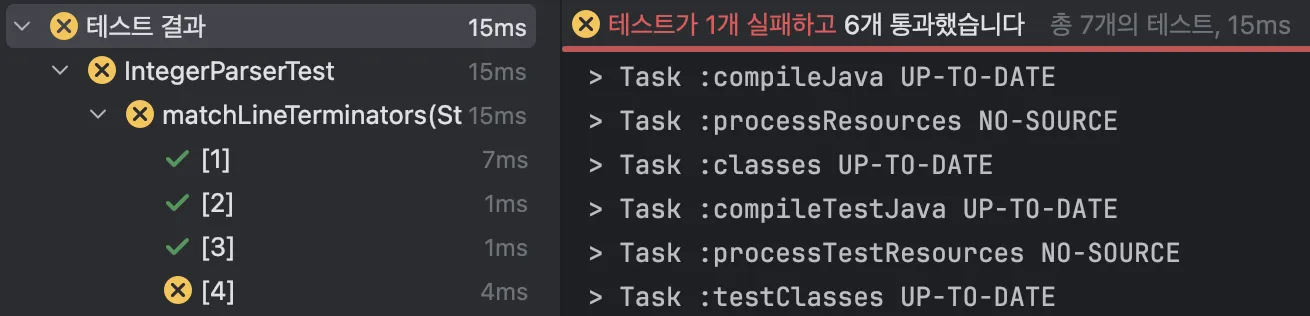
플래그를 설정해주면 동일한 규칙도 다르게 동작한다. DOTALL 플래그는 .(DOT)이 예외로 두었던 line terminator 문자들도 하나의 문자로 취급하도록 만든다. 다만, "." 규칙은 정확히
하나의 문자를 대표하기에 2개의 문자로 구성된 "\r\n" 케이스는 매칭되지 않는 것을 볼 수 있다.
@ParameterizedTest
@ValueSource(strings = {" ", "\n", "\r", "\r\n", "\u0085", "\u2028", "\u2029"})
void matchLineTerminators(String lineTerminator) {
	Pattern p = Pattern.compile(".", Pattern.DOTALL);
	Matcher m = p.matcher(lineTerminator);
	assertTrue(m.matches());
	assertEquals(lineTerminator, m.group());
}
CASE 3: ".+" & DOTALL
+ 기호는 특정한 패턴을 1번 이상 반복되는 경우로 확장시킨다. 이를 통해, 2개의 문자로 이루어진 "\r\n" 케이스도 테스트를 통과하게 된다. 참고로 ".{1,2}"와 같이 반복 횟수의 하한과 상한을
명시하는 것도 가능하다.
@ParameterizedTest
@ValueSource(strings = {" ", "\n", "\r", "\r\n", "\u0085", "\u2028", "\u2029"})
void matchLineTerminators(String lineTerminator) {
	Pattern p = Pattern.compile(".+", Pattern.DOTALL);
	Matcher m = p.matcher(lineTerminator);
	assertTrue(m.matches());
	assertEquals(lineTerminator, m.group());
}
CASE 4: ".+"
DOTALL이 빠지면 당연하게도 결과는 CASE 1과 동일해진다. (결과 생략)